
In short
Interior demolition, or strip-out, removes everything inside a property that the renovation will replace, leaving a clean, sorted shell. A soft strip takes out fittings and finishes only; a full strip-out also removes partitions, screeds and installations. The work follows a fixed sequence from top to bottom, with waste separated by material.
Contents
Soft strip or full strip-out?
A soft strip removes the non-structural contents and finishes: kitchen units, sanitary ware, doors, wardrobes, false ceilings, floor coverings, light fittings and loose installations. Partitions and screeds stay. It is the right choice when the layout works and only the finishes are tired.
A full strip-out goes further: partitions come down, screeds are broken out where the new floor needs it, old pipes and cables are removed back to their entry points, and the property is left as a bare structure. It is the choice when the layout changes – a house knock-through joining kitchen and living room, two bedrooms becoming one – or when old installations are being replaced throughout. Structural elements are never part of a strip-out unless a técnico has designed their removal; that is covered on the page on wall removal.
The strip-out process, room by room
Every strip-out follows the same logic: protect first, remove from the top down and from the inside out, and sort as you go.
- Survey and scope. A written list of what goes and what stays, room by room.
- Services. Water, gas and electricity isolated and capped by the relevant installers.
- Protection. Lift, landings, stairs and anything that stays inside the property.
- Soft strip. Furniture left behind, doors, wardrobes, kitchen units, sanitary ware and fittings.
- Ceilings. False ceilings and loose plaster.
- Partitions. Non-structural walls, with edges cut where they meet walls that stay.
- Wall finishes and floors. Tiles, render, coverings and screeds to the agreed layer.
- Clean shell. Swept, photographed and handed over.
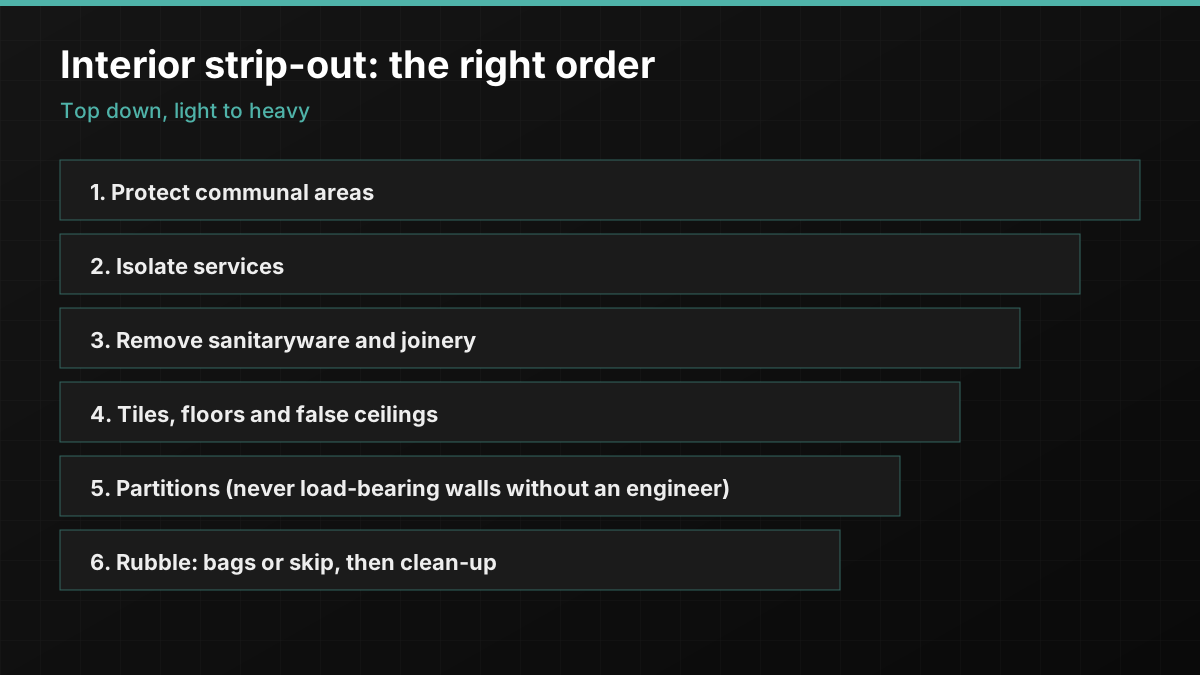
The individual stages have their own pages: kitchens and bathrooms, floors and ceilings and hand demolition as the technique behind most of it.
Apartment strip-out in a community of owners
An apartment strip-out happens with neighbours on every side, so the community is part of the plan from the start. Under the Ley de Propiedad Horizontal, the community has to be informed before walls, structure or façade elements are demolished, and works affecting common elements need the agreement of the owners' meeting. In practice we contact the administrator, agree dates and hours of noisy work, post a notice in the entrance and protect the lift before anything leaves the flat.
The guide strip-outs in a community of owners explains what to send the administrator and what the community can ask of you.
Managing a strip-out from abroad
Many owners are not in Spain while their property is being emptied. That works well if the arrangements are clear: someone who holds the keys and lets us in, the administrator's contact, the técnico's details if one is involved, and an agreed way of reporting. You receive photos of each stage by WhatsApp or e-mail, and any surprise – a hidden beam, damp in a slab, fibre-cement pipes – is reported with a picture before anyone acts on it.
The blog post the best way to strip out an apartment you rarely visit lists what to settle before you fly home, and what a strip-out with us looks like, day by day describes a typical programme.
Permits and documentation
Which procedure a strip-out needs depends on what it involves – finishes only, a new layout or structure – and on the town hall, which sets it in its ordinance. In Andalusia, partial demolition of buildings is done by declaración responsable since 2024 unless the building is protected or in a protected setting, where a licencia urbanística is needed; in Málaga city the works declaración responsable comes with a project or technical report signed by a técnico competente, a technical certificate and photographs. Ask your técnico or the ayuntamiento which procedure applies. We do not file it, but we tell you what is usually requested and adapt our programme to it.
Where several companies or self-employed workers take part in the same job, the Real Decreto 1627/1997 requires the promotor to appoint a health and safety coordinator during execution, and the contractor works to its own health and safety plan.
Waste: sorted, removed, documented
A full strip-out produces several tonnes of mixed material, and the law requires it to be sorted. Since 2022, the Ley 7/2022 requires non-hazardous construction and demolition waste to be separated at least into wood, mineral fractions, metals, glass, plastic and plaster, and selective demolition is mandatory since 1 January 2024. In an apartment that means separate bags for ceramic rubble, gypsum, metal, wood and plastics from the first day. The waste goes to an authorised waste manager and you receive the delivery receipts; the town hall may require a waste deposit or guarantee, returned when delivery to an authorised manager is proven.
If asbestos-containing materials appear, they are handled separately by a RERA-registered company working as our subcontractor; the guide on hidden asbestos in interior renovations explains where to expect them.
Who is a full strip-out right for?
A full strip-out makes sense when you are changing the layout, replacing all installations, or buying a property whose interior is beyond saving. It is less sensible when the bones of the interior are good and only a few rooms need work; then a targeted kitchen or bathroom strip-out costs less and disturbs the building less. The blog post who is a full strip-out right for? goes through the cases.
When the project grows beyond the interior – the whole villa is to be demolished and rebuilt – the right service is on the network's pillar site for house and villa demolition.
Cost and quotes
The cost of a strip-out depends on the area, how deep the removal goes, the construction of walls and floors, the floor and access, the hours allowed for noisy work and the volume of each waste fraction. Two apartments of the same size can differ widely: one with laminate and plasterboard, another with terrazzo on a mortar bed and brick partitions. The blog post what affects the cost of an interior strip-out in Spain explains each factor, and the network's interior demolition cost page shows how they combine. Our quotes list the scope room by room, so that you can compare them with others; the strip-out contractor checklist helps with that comparison.
Frequently asked questions
How long does an apartment strip-out take?
It depends on the size, the depth of removal and how easily rubble can leave the building. We give a programme with the quote; a soft strip is much shorter than a full strip-out with screeds.
What is a soft strip?
The removal of fittings, finishes and non-structural items such as kitchen units, sanitary ware, doors, false ceilings and floor coverings, while partitions and screeds stay.
What is a house knock-through?
Joining two rooms by removing the wall between them, most often a kitchen and a living room. If the wall is load-bearing, a técnico must design the opening first.
Do you remove furniture left in the property?
Furniture and household items left behind can be removed as part of the soft strip if they are included in the scope. Tell us what is there so it can be sorted properly.
Do I have to empty the apartment before you start?
Personal belongings you want to keep should be removed or listed. Everything else agreed in the scope is taken out by us.
Will the strip-out include the old electrics and plumbing?
Yes, in a full strip-out the old pipes and cables are removed back to the entry points, after the installers have isolated and capped them.
Can you strip out an apartment while I am abroad?
Yes. We need access, the administrator's contact and the técnico's details if structure is involved. You follow progress through photos at each stage.
Who coordinates health and safety on the job?
The contractor works to its own health and safety plan. When several companies or self-employed workers take part, the promotor must appoint a health and safety coordinator during execution.
What will the apartment look like when you finish?
A clean shell: bare walls, ceilings and floors to the agreed layer, services capped, rubble removed and the space swept. You receive a final set of photos.
Can you strip out a villa as well as apartments?
Yes. Villas are stripped with the same sequence; the main differences are distances to the loading point, higher ceilings and sometimes floors laid directly on the ground.