
In short
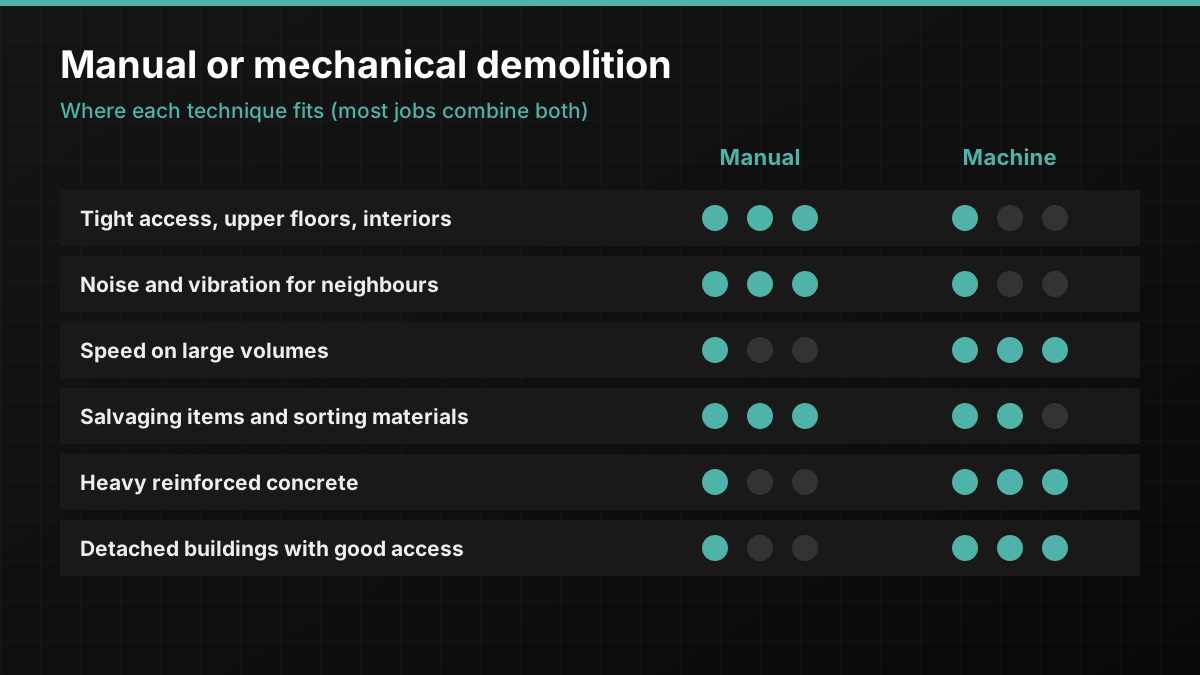
Hand demolition, or manual demolition, uses sledgehammers, crowbars, electric demolition hammers and cutting tools instead of excavators. It is used where weight, vibration or access rule out machines, or where elements must be removed selectively. It is slower than mechanical demolition but precise, quieter for neighbours and well suited to sorting waste.
Contents
What is hand demolition?
Hand demolition is demolition carried out by people with hand-held tools rather than by machines. The toolkit is simple – sledgehammers, crowbars, chisels, electric demolition hammers and breakers, disc cutters and saws – but the method behind it is not: elements are removed in a planned order, from the top down and from the lightest to the heaviest, so that nothing falls or loads a structure unexpectedly.
In the provincia de Málaga, hand demolition is the normal technique inside apartments, on roofs and terraces of multi-storey buildings, in old town houses reached by narrow streets, and wherever part of a building must be removed while the rest stays in use.
When is manual demolition the right choice?
- Inside buildings: walls, floors, ceilings, kitchens and bathrooms in flats, where a machine would overload the slab and cannot get through the door.
- On roofs: removing flat-roof layers – tiles, screeds, insulation, waterproofing – before the roof is rebuilt.
- Next to what stays: openings in walls, partial removal of a staircase or a balcony finish, where the edge has to be clean.
- In occupied buildings: where vibration and noise must be kept to a level the neighbours can tolerate.
- With difficult access: historic centres, stepped streets, gardens without vehicle access.
- Selective demolition: where materials have to come off one by one – timber, metal, tiles – so that they can be separated.
The blog post hand demolition vs machine demolition indoors compares the two approaches in detail.
Tools and protection
The choice of tool follows the material. Plasterboard and timber are cut and levered; brick partitions are taken down with hammers and chisels; screeds, tiles on mortar and light concrete need electric breakers; clean edges are cut with discs before breaking. Dust is reduced with water where the surface allows it, with sealed work areas and with extraction during cutting.
Electric tools are preferred indoors over petrol or pneumatic equipment: they produce no exhaust in closed rooms, need no compressor on the landing and are easier to control on thin partitions next to a neighbour's flat. For long runs of tiles or screed, a heavier breaker saves time; for edges and junctions, a lighter hammer and a chisel give a cleaner line.
Protection works on two levels. For the people doing the work: eye, ear, hand and foot protection, masks suited to the dust, and safe platforms for work at height. For the building: floors and fittings that stay are covered, shared areas are protected, and debris is never thrown from height without a closed chute. Our guide hand demolition explained describes the tools and protective measures in more depth.
Flat roofs and terraces
Flat roofs on Costa del Sol apartment buildings are built in layers: finishing tiles, a mortar bed, waterproofing membranes, insulation and a sloped screed over the structural slab. When the roof leaks or is being rebuilt, those layers come off by hand, because a machine on a roof is out of the question. Work proceeds strip by strip so that the roof is never left open over a large area if rain is forecast, and the rubble is lowered in bags or through a closed chute.
If the roof is covered with corrugated fibre-cement sheets rather than a flat finish, that is a different job: uralita removal is carried out by a RERA-registered company working as our subcontractor, and our sister site explains uralita roof removal.
Demolition robots and engineered deconstruction
Between pure hand work and a full-size excavator there is a middle ground. A demolition robot is a compact, remote-controlled machine carrying a breaker or crusher, light enough for some interiors and narrow accesses. It suits jobs with a lot of concrete to break in a confined space, such as a thick floor in a ground-floor commercial unit or a basement. Whether a robot is appropriate depends on the slab's capacity, the access and the volume of work; we tell you honestly at the survey whether the job calls for one, and how it would be arranged is confirmed for each job.
Engineered deconstruction is the planned, piece-by-piece dismantling of a structure in the reverse order of its construction, following a sequence defined by a técnico. It is used where elements must be removed without destabilising what remains – a mezzanine, a staircase, a section of slab. We carry out the demolition part following that sequence.
Sorting waste at source
Hand demolition is the easiest way to meet the waste-sorting requirements of the Ley 7/2022, which since 2022 requires non-hazardous construction and demolition waste to be separated at least into wood, mineral fractions, metals, glass, plastic and plaster, and makes selective demolition mandatory since 1 January 2024. Because elements come off one by one, they go straight into the right bag: ceramics in one, gypsum in another, metal and timber separately. The waste goes to an authorised manager and you receive the delivery receipts.
Hand demolition as part of a bigger job
Many demolitions combine both techniques. On a house demolition, the interior is often stripped by hand first – fittings, timber, metal – and the structure then comes down by machine; the photo below, from one of our own jobs, shows brick and timber separated this way before the plot is cleared. When the whole building has to go, the pillar site of the network covers building demolition; when it is the interior of an apartment, see full interior strip-out or wall removal.

Cost factors for manual work
Hand demolition is priced by effort rather than by area: the hardness and thickness of the material, the height of work, access to the loading point and the hours allowed for noisy work all count. It is more labour-intensive than machine work but often avoids costs that machines bring, such as cranes, reinforcement of slabs or damage to finishes that stay. The network's interior demolition cost page explains the factors.
Frequently asked questions
Is hand demolition slower than using machines?
Yes, per tonne of material it is slower. It is chosen when precision, weight limits, access or the presence of neighbours matter more than speed.
What tools are used in manual demolition?
Sledgehammers, crowbars, chisels, electric demolition hammers and breakers, disc cutters and saws, plus platforms or scaffolds for work at height.
Can a whole house be demolished by hand?
Small structures can be, but it is rarely the sensible option for a whole house. The usual approach is to strip the interior by hand and bring the structure down by machine.
What is a demolition robot?
A compact, remote-controlled machine with a breaker or crusher, light enough for some interiors and tight accesses. It is useful where there is a lot of concrete to break in a confined space.
Do you use demolition robots?
We assess at the survey whether a robot suits the job, considering the slab, access and volume of work. How it would be arranged is confirmed for each job; we do not promise one in advance.
What is engineered deconstruction?
The planned dismantling of a structure piece by piece in reverse order of construction, following a sequence set by a técnico. It is used when part of a structure must be removed without affecting the rest.
How do you control dust in hand demolition?
Work areas are sealed, surfaces are dampened where possible, cutting tools are used with extraction and debris is bagged as it is produced.
Is hand demolition quieter?
It is quieter than a breaker mounted on a machine and causes far less vibration, although electric breakers on screeds and tiles are still loud. Noisy tasks are grouped into agreed hours.
Can you remove the layers of a flat roof?
Yes, tiles, mortar beds, membranes, insulation and screeds are removed by hand in strips, so the roof is not left open over a large area.
Does hand demolition make waste sorting easier?
Yes. Elements are removed one at a time, so ceramics, gypsum, timber and metal go straight into separate bags, as the waste law requires.