
In short
A commercial strip-out removes the fit-out of a shop, bar, restaurant or office – partitions, ceilings, floor coverings, counters, kitchens and installations – back to an agreed shell condition. The scope comes from the lease or the new design, the waste is separated by fraction for an authorised manager, and the unit is handed over clean.
Contents
- When is a commercial strip-out needed?
- What comes out of a shop, bar or restaurant?
- Offices and medical or professional premises
- How is the work organised in an occupied building?
- Permits, the landlord and the community
- Waste from commercial units
- What drives the cost of a commercial strip-out?
- Handing the unit back: what the landlord usually checks
- What to send for a commercial quote
- Frequently asked questions
When is a commercial strip-out needed?
A commercial strip-out is needed when a unit has to be returned to a basic condition or prepared for a completely different use. The typical cases are a tenant handing back premises at the end of a lease, a landlord preparing a unit for marketing, and a new tenant whose architect needs an empty space before the new fit-out is designed.
Each starts from a different document. For a hand-back it is the lease, which often describes the condition in which the unit must be returned; for a new fit-out it is the designer's drawings, which show what can stay. We ask for whichever applies, because the scope is not ours to guess.
What comes out of a shop, bar or restaurant?
- Front of house: counters, bars, shelving, display units, mirrors, signage and decorative wall finishes.
- Kitchens: cooking lines, extraction hoods, stainless worktops, cold-room panels, grease traps and wall tiling. Gas is disconnected by an authorised installer first.
- Partitions and ceilings: plasterboard walls, toilets, storerooms, suspended ceilings and their grids.
- Floors: vinyl, laminate, carpet tiles, ceramic tiles and, where specified, raised platforms or screeds.
- Installations: redundant cabling, lighting, ducts and air-conditioning units, removed once disconnected by the relevant installer.
Equipment the owner wants to sell or keep is identified and set aside before demolition starts; we do not buy or resell it.
Offices and medical or professional premises
Office strip-outs are usually lighter and more repetitive: demountable partitions, suspended ceiling tiles, raised floors, carpet tiles, data cabling and kitchenettes. The challenge is volume and logistics rather than heavy breaking. In buildings with other offices in use, the work is phased floor by floor or zone by zone and the noisiest tasks are scheduled for hours agreed with the building management.
How is the work organised in an occupied building?
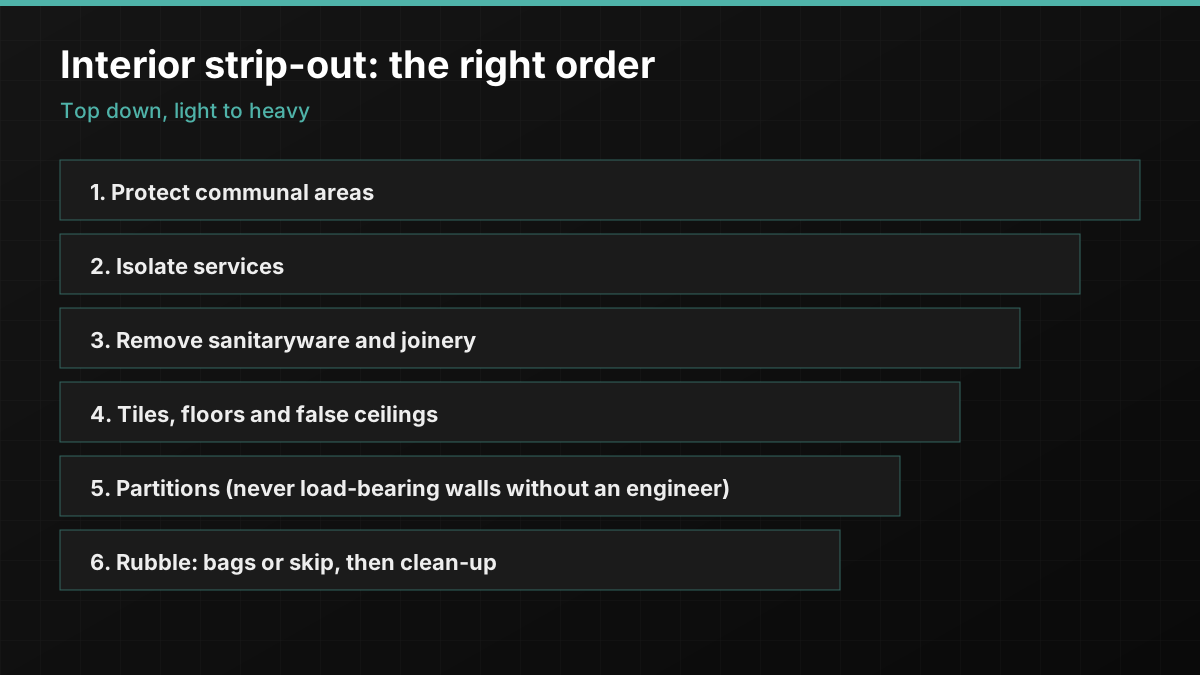
Most commercial units on the Costa del Sol sit at street level under apartments. A strip-out there has to respect the residents above, the pavement in front and the neighbouring businesses on each side. The sequence we follow is always the same: survey and written scope, disconnection of services, protection of shared areas and the shopfront, soft strip of fittings and finishes, then partitions, ceilings and floors, and finally a clean sweep.
Loading is the part that needs the most planning. If a skip or a vehicle has to stand on the street, occupying the public road needs authorisation from the town hall, and in some municipalities, such as Benalmádena, the road may not be occupied with skips or materials without a permit. Larger volumes are handled with our sister site for rubble removal and skips. The guide commercial strip-out step by step walks through each phase.
Permits, the landlord and the community
A commercial strip-out may need a declaración responsable or another procedure depending on what is removed and on the town hall's ordinance; if it affects structure or the façade, a técnico's documentation is required. In a building under propiedad horizontal, the community must be informed before walls, structure or façade elements are demolished, and works affecting common elements need the owners' meeting agreement. The landlord usually has to approve the scope too. We do not file these procedures, but we tell you what is usually asked for and work from the documents once they are in place.
Waste from commercial units
Commercial fit-outs produce mixed waste: plasterboard, metal studs and ceiling grids, timber, glass, plastics, ceramics and cabling. Under the Ley 7/2022 non-hazardous construction and demolition waste has to be sorted at least into wood, mineral fractions, metals, glass, plastic and plaster, so each type is collected separately from the start. The waste is delivered to an authorised manager and you receive the receipts, which landlords and incoming tenants often want for their own file.
Older premises sometimes hide fibre-cement ducts, flues or panels. Those stop the work in that area until a RERA-registered company, working as our subcontractor, removes them under its own approved plan; the guide on hidden asbestos in interior renovations shows where to look.
What drives the cost of a commercial strip-out?
The main factors are the floor area, the density of the fit-out (a restaurant kitchen is far heavier than an open office), whether floors and screeds come up, the loading conditions on the street, the working-hour restrictions and the volume of each waste fraction. The blog post cheap vs expensive strip-out quotes explains why two quotes for the same unit can differ so much, and the network's interior demolition cost page sets out the factors one by one.
If the unit is in an apartment building and the job extends into the residential floors, see full interior strip-out; if the floor slab or a concrete platform has to be broken, see floors and ceilings.
Handing the unit back: what the landlord usually checks
At the end of a lease, the landlord or their agent normally inspects the unit against the hand-back clause. The points that cause disputes are predictable: fixings and anchors left in walls and floors, cables cut but not removed, capped services that are not labelled, adhesive residue where flooring was lifted, and rubble left in storerooms or on the roof. We go through the unit with that list before calling it finished, photograph each area and pass the photos and the waste receipts to whoever commissioned the work, which gives the outgoing tenant a clear record if the condition of the unit is ever questioned.
What to send for a commercial quote
- Photos or a video walk-through of each area, including the kitchen, toilets and storerooms.
- The floor plan and, for a hand-back, the clause of the lease that describes the return condition.
- The address, the street access and whether a vehicle can stop in front.
- Equipment that stays or will be collected by its owner.
- The handover deadline.
Frequently asked questions
What does shell condition mean?
It usually means the unit is returned without the tenant's fit-out: bare walls, floor and ceiling, with the building's own services capped at their entry point. The exact definition comes from the lease, so we work from its wording.
Can you strip out a restaurant kitchen?
Yes. After the gas and electricity have been disconnected by authorised installers, we remove the cooking line, hoods, stainless surfaces, tiling and partitions, and separate the metal from the rest of the waste.
Do you buy or resell the old equipment?
No. We do not buy or sell equipment or reclaimed materials. If you want to keep or sell something, tell us before work starts and it will be set aside.
Can the work be done at night or at weekends?
Noisy work is restricted by community rules and municipal ordinances, so night work is rarely possible in residential buildings. We agree the hours with the building management and plan around them.
How long does a shop strip-out take?
It depends on the area, the density of the fit-out and how easily rubble can be loaded on the street. We give a programme with the quote once we have seen the unit.
Do I need a permit to strip out a commercial unit?
It depends on the works and on the town hall's ordinance; anything structural or affecting the façade needs a técnico's documentation. Your técnico or the ayuntamiento can confirm the procedure.
Can you remove the shopfront signage?
Yes, as part of the strip-out, once it has been electrically disconnected. If it is fixed to the façade, the community may need to be informed.
Who receives the waste receipts?
Whoever commissions the work, usually the outgoing tenant or the landlord. Many landlords ask for them as proof that the waste was managed properly.
Can you work while neighbouring shops stay open?
Yes. The shopfront is screened, dust is contained inside the unit and loading is scheduled around the street's busiest hours.
Do you strip out units outside Málaga city?
Yes, anywhere in the provincia de Málaga, from Estepona and Marbella to Torremolinos, Vélez-Málaga, Antequera and Ronda.