In short
Indoors, hand demolition is usually the better choice in occupied buildings, apartments and anywhere precision, low vibration and protection of elements that stay matter. Compact machines and demolition robots make sense for large volumes of concrete or masonry in commercial or industrial interiors with good access and strong floors. Many jobs combine both.

Contents
- What counts as hand demolition and machine demolition indoors?
- How do the two methods compare side by side?
- When is hand demolition the better choice?
- When do machines make sense indoors?
- Why do many jobs combine both methods?
- How do dust and neighbours factor in?
- What about cost and time?
- How do you decide for your property?
- Frequently asked questions
What counts as hand demolition and machine demolition indoors?
Hand demolition indoors means work done by people with hand-held tools: crowbars, sledgehammers, chisels, electric demolition hammers, saws and cutters. The tools can be powerful, but each blow or cut is controlled by the operator standing next to the element.
Machine demolition indoors means compact equipment brought into the building: remote-controlled demolition robots with breakers or crushers, mini excavators in large ground-floor spaces, or wall and floor saws on rails. These machines are much smaller than those used to bring down a whole building, but they are still heavy and they need access, space and a floor that can carry them. Wall and floor saws are a special case: they cut rather than break, so they produce clean edges and far less vibration, but they need water or extraction to control the slurry and dust.
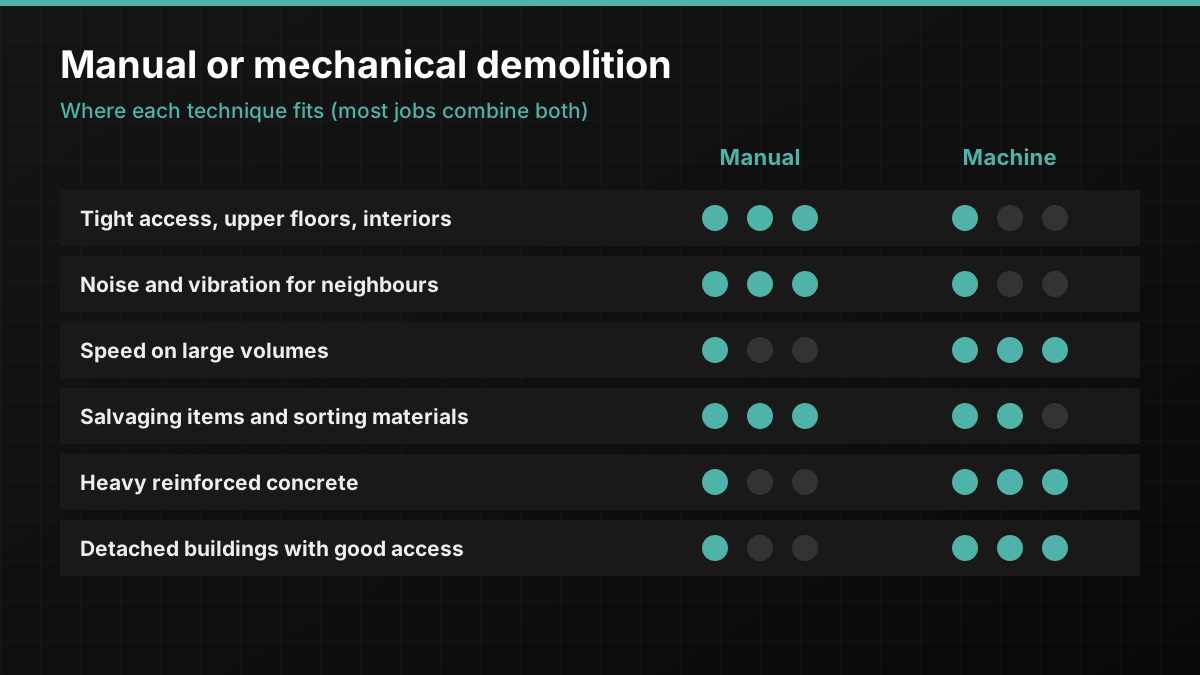
How do the two methods compare side by side?
| Criterion | Hand demolition | Compact machines / robots |
|---|---|---|
| Precision next to elements that stay | High | Good with skilled operators, lower at the edges |
| Vibration transmitted to the structure | Low to moderate | Moderate to high with breakers |
| Noise | Intermittent | Continuous for longer periods |
| Access needed | Stairs and doorways are enough | Lift capacity, door widths, ramps |
| Floor load | Negligible | Must be checked, sometimes with props below |
| Output on thick concrete | Slow and tiring | Much faster |
| Waste sorting at source | Easy | Possible, but material is more mixed |
The table explains why most residential strip-outs on the Costa del Sol are done by hand: precision, low vibration and simple access count for more than raw output.
When is hand demolition the better choice?
Hand work wins whenever the building is occupied, the job is in an upper-floor apartment, or there are elements to keep. Typical cases are kitchen and bathroom strip-outs, removing partitions next to a staircase or a façade, lifting tiles over underfloor pipes, or working near original features such as timber beams or a period ceiling.
It is also the natural method where access rules out machinery: narrow lifts, spiral stairs, historic centres where nothing larger than a hand trolley gets through the door. Our hand demolition service explains the tools and protection we use, and the guide hand demolition explained goes into technique.
When do machines make sense indoors?
Compact machines earn their place when the volume of hard material is large and the space suits them. Examples include breaking out a thick concrete floor in a commercial unit, removing heavy masonry walls in a ground-floor warehouse being converted, or demolishing internal concrete elements in a building that is empty and will be refurbished floor by floor.
Before a machine goes in, three things must be confirmed: that it physically fits through the access route, that the floor can carry it (if necessary with the técnico's assessment and props below), and that the vibration and noise are acceptable for the building and its neighbours. For bigger mechanical jobs outside the scope of an interior strip-out, our sister site derribosindustrialesmalaga.eu covers machine demolition.
Why do many jobs combine both methods?
In practice the choice is often not either-or. A typical combined job starts by hand: removing fittings, separating wood, metal and plasterboard, protecting what stays and cutting clean edges. Then, if there is a large volume of concrete or masonry, a compact machine breaks the bulk material. The final work at edges and joints is again done by hand.
This sequence keeps waste fractions clean, which matters because Ley 7/2022 requires sorting into the main fractions, and it keeps the machine away from the delicate parts of the job. It is the logic we follow on commercial strip-outs where shop fronts, shared walls and installations have to survive the work.
How do dust and neighbours factor in?
Dust behaves differently with each method. Hand work breaks material into larger pieces and produces dust in short bursts that can be controlled with water mist, local extraction and sealed doorways. A breaker on a machine works continuously and grinds more of the material into fine particles, so dust control needs to be planned more carefully, especially in a building where people live.
Neighbours notice vibration more than noise. A demolition hammer used on a partition is loud but brief; a breaker working on a concrete floor sends vibration through the slab into the flats around it for hours. In apartment blocks, municipal noise ordinances and community rules usually set working hours, and the guide on noise, dust and working hours explains what to agree beforehand. For most residential buildings these considerations alone settle the choice in favour of hand work.
What about cost and time?
Owners often assume a machine is always cheaper because it is faster. That is true only when the volume is big enough to justify bringing it in, setting it up and protecting the route, and when the access does not slow it down. For a typical apartment, the set-up effort of a machine outweighs the time saved, so hand work is usually the more economical option.
We do not quote figures here; the main cost factors for interior work are explained in our post on what affects the cost of an interior strip-out, and the calculator gives a rounded band.
How do you decide for your property?
The method follows from a few questions that we ask before quoting:
- Is the building occupied, and how sensitive are the neighbours to noise and vibration?
- What is the access route, and what are the dimensions of the lift, doors and stairs?
- How much hard material is there, and how thick is it?
- Which elements must survive untouched?
- What does the técnico say about floor loads, if machinery is being considered?
Send us photos and a description through the contact page and we will explain which approach fits, and why, before you commit to anything.
Frequently asked questions
Is hand demolition slower than using a machine?
On large volumes of thick concrete, yes. On typical apartment strip-outs the difference is small, because a machine needs access, set-up and protection that hand work does not.
What is a demolition robot?
A compact, remote-controlled machine fitted with a breaker, crusher or other tool, used for heavy interior work where a person with a hand-held hammer would be too slow.
Can a machine be used in an apartment?
Rarely. Lift capacity, door widths, floor loads and vibration for the neighbours usually rule it out, so apartments are stripped by hand.
Does hand demolition make less noise?
It produces intermittent noise rather than long continuous periods, and less vibration. It is still noisy, so working hours and neighbours must be considered.
Who decides whether a floor can carry a machine?
A técnico, based on the structure. If needed, props are placed on the floor below.
Is hand demolition safer for the structure?
For work next to elements that stay, yes, because vibration and impact are lower and each cut is controlled.
Does the method change how waste is sorted?
Hand work makes sorting at source easier; machine work produces more mixed material. Either way, the main fractions must be separated as required by Ley 7/2022.
Can you combine hand work and machines in one job?
Yes, and in commercial interiors that is common: fittings and delicate areas by hand, bulk concrete by machine, edges by hand again.
What tools are used in hand demolition?
Crowbars, sledgehammers, chisels, electric demolition hammers, cutters and saws, with dust control and personal protection.
Is machine demolition cheaper indoors?
Only when the volume justifies it and access is good. For most homes, hand work is the more economical choice.