In short
Without a usable lift, rubble from a flat leaves in closed bags carried down the stairs, through a rubble chute fixed to the façade or a light well, or with a material hoist, and is then loaded into a skip or a truck. The right method depends on the floor, the volume, the community's agreement and whether the street allows a skip. Demolición Interior Málaga sorts the waste on site and delivers it to an authorised manager, handing you the delivery receipts.

Contents
- Why the rubble route matters more than the demolition
- Option 1: bags down the stairs
- Option 2: a rubble chute
- Option 3: hoists and lifting equipment
- Skip, truck or bags on the street?
- Sorting the waste on the way out
- Receipts, deposits and paperwork
- Questions to answer before day one
- How the route changes the plan and the cost
- Frequently asked questions
Why the rubble route matters more than the demolition
On many interior jobs the demolition itself is the quick part. A bathroom can be stripped in a short time; carrying its tiles, screed, sanitary ware and brick down five floors of stairs can take as long again. In buildings without a lift, or where the community does not allow rubble in it, the route out decides the size of the crew, the number of days and much of the effort behind the quote.
The volume is also larger than owners expect. Demolished material takes up much more space than it did in the wall or floor, and a single bathroom with screeded floors and tiled walls fills a surprising number of bags. Planning the route before the first tile comes off avoids rooms full of rubble with nowhere to go.
Option 1: bags down the stairs
The most common solution in older blocks and townhouses is the simplest: rubble is broken to a manageable size, put into strong bags and carried down by hand.
- When it fits: small and medium jobs, narrow streets, buildings where nothing may be fixed to the façade.
- What it needs: protection of the stairs and landings, corner guards, a clear agreement on times so that neighbours are not blocked, and enough people to rotate carrying.
- Limits: heavy materials such as screed and concrete make this slow on high floors; bags must not be overfilled, both for safety and to avoid splitting on the stairs.
Bags are filled by material wherever possible – ceramics in one, plasterboard in another, metal separately – so the sorting starts in the flat, not at the skip.
Option 2: a rubble chute
A rubble chute (bajante de escombros) is a series of linked tubes fixed from an upper window or balcony down to a skip at ground level. Rubble is dropped into the top and slides down inside the tube, which keeps dust and noise lower than open dropping.
- When it fits: larger strip-outs, higher floors, and buildings where a skip can stand directly below the opening.
- What it needs: the community's agreement, because the chute is fixed to or hangs over the façade or a common light well; and, if the skip stands on the street, authorisation to occupy the public road.
- Limits: not every façade has a suitable opening above a usable skip position; balconies, awnings and windows below have to be protected; and only suitable material goes down it – nothing long, nothing that could jam.
Because the chute touches common elements, it should be part of the notice to the community described in our guide to community of owners rules.
Option 3: hoists and lifting equipment
For heavy or bulky items, or when the stairs are very narrow, a material hoist or small lifting equipment can bring loads down the outside of the building. This is more common on larger renovations and commercial units than in a single flat.
It requires a safe anchoring point, a secured zone below, the community's agreement if it uses the façade and, when it stands on the street, the public road permit. It is planned as part of the health and safety documentation of the job, which under Real Decreto 1627/1997 every construction or demolition job has in the form of an estudio de seguridad y salud or an estudio básico, with the contractor's plan prepared from it.
In practice, many jobs combine methods: bags down the stairs for most of the material, and a hoist or the lift (if allowed) for a few heavy items such as a cast-iron bath.
Skip, truck or bags on the street?
Whatever the route down, the rubble needs somewhere to go at street level. The usual choices are:
| Option | Best for | What to check |
|---|---|---|
| Skip (contenedor) on the street | Medium and large volumes, several days of work | Public road occupation permit; position that does not block garages or traffic |
| Skip on private land or in a garage area | Villas and buildings with private forecourts | Community agreement if the area is common |
| Direct loading onto a truck | Narrow streets where a skip cannot stand | Loading times and a short, safe stopping point |
| Large bags (big bags) collected by truck | Small jobs, historic centres | Where the bags can wait and how often they are collected |
Occupying the street needs authorisation. Mijas requires prior authorisation for works affecting the public road, and Benalmádena does not allow skips or materials on the road without a permit. Other towns have their own rules: before starting, check with the town hall which procedure applies. For the street-side logistics of larger volumes, our sister site explains rubble removal and skips.
Sorting the waste on the way out
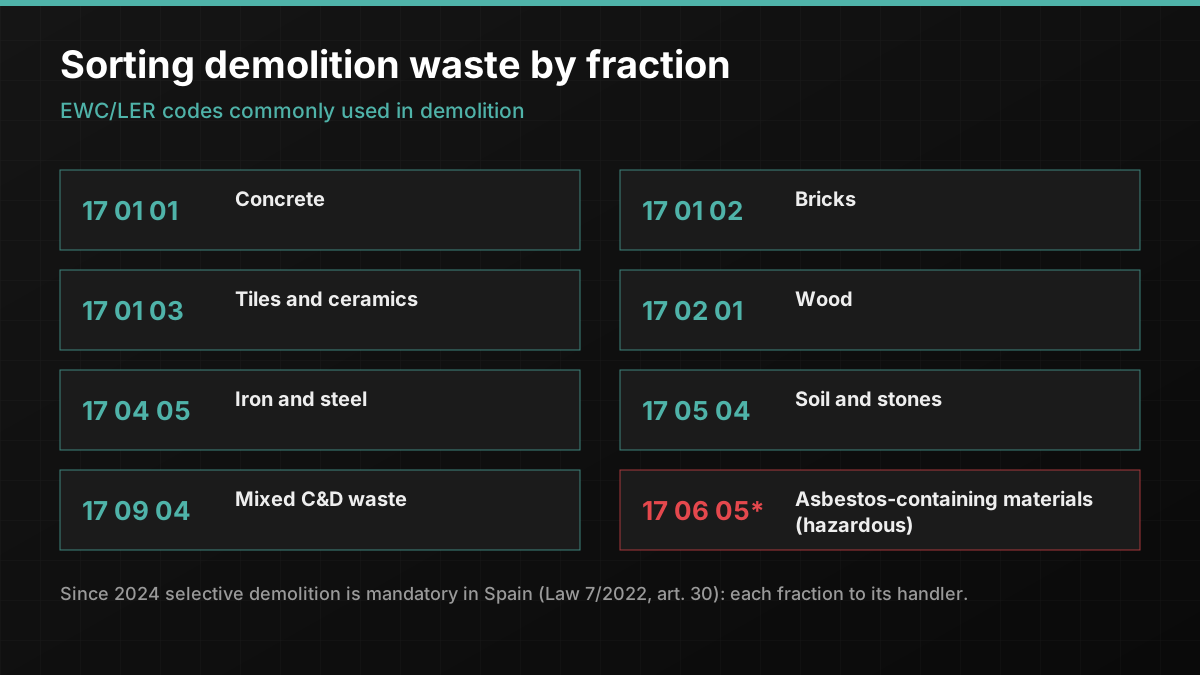
Rubble is not one material, and the law no longer treats it as one. Under the Ley 7/2022 on waste, non-hazardous construction and demolition waste has had to be sorted since July 2022 at least into wood, mineral fractions, metals, glass, plastic and gypsum, and selective demolition has been mandatory since 1 January 2024. For an interior strip-out that translates into a few typical fractions:
| Material from the flat | LER/EWC code |
|---|---|
| Tiles, sanitary ware, ceramic pieces | 17 01 03 – tiles and ceramics |
| Brick partitions | 17 01 02 – bricks |
| Mixed screed, brick and tile rubble | 17 01 07 – mixtures of concrete, bricks, tiles and ceramics |
| Plasterboard, gypsum plaster | 17 08 02 – gypsum-based construction materials |
| Doors, skirting, timber frames | 17 02 01 – wood |
| Radiators, pipes, metal frames | 17 04 05 – iron and steel |
| Window glass | 17 02 02 – glass |
| Plastic pipes and packaging | 17 02 03 – plastic |
Material that contains asbestos is never mixed with the rest: it is handled separately as hazardous waste (17 06 05*) by a RERA-registered company. Sorting in the flat, bag by bag, is what makes this possible without double handling.
Receipts, deposits and paperwork
Once the waste leaves the building, it goes to an authorised facility or manager, and you receive the delivery receipts (justificantes de entrega). Keep them: the town hall requires a fianza or guarantee for construction waste, set by each municipal ordinance, and it is returned when delivery to an authorised manager is proven.
On jobs with a project, the técnico includes an estudio de gestión de residuos and the contractor prepares a plan de gestión de residuos for the works, approved by the site's technical direction. On small repair works in a home, the waste counts as household waste; your town hall's rules decide how it is handled.
Questions to answer before day one
A short survey of the route, in person or by photos and video, answers most of the logistics before the crew arrives. These are the questions we work through with owners, many of whom are not in Spain at the time:
- Which floor, and how are the stairs? Width, number of turns, handrails and any tight landings decide bag size and how many people carry at once.
- Is there a lift, and may it be used? If the community allows it under conditions, those conditions go into the programme.
- Is there a window, balcony or light well above a possible skip position? That is the precondition for a chute.
- Where can a skip or truck stand? Street width, garage entrances, loading restrictions and the distance from the portal.
- What will be removed? A strip-out of plasterboard and kitchen units is a very different load from tiled floors on thick screed.
- When can loading happen? Times agreed with the administrator, and any restrictions in pedestrian streets.
With these answers we can tell you which method we propose, how the rubble will be sorted and what the community and the town hall need to know in advance. Video of the walk from the flat to the street is often the single most useful thing an owner abroad can send.
How the route changes the plan and the cost
Because carrying is so much of the work, the rubble route is one of the main cost factors of a strip-out without a lift. The factors that move it most are:
- the floor and the width and turns of the stairs;
- the type of material – screed and concrete weigh far more than plasterboard;
- whether a chute or a skip below is possible;
- distance from the portal to where the skip or truck can stand;
- time restrictions agreed with the community.
We do not publish prices, but you can get an indicative range on our sister site's demolition cost calculator. For a firm figure, send photos of the rooms, the stairs and the street. The rubble route is planned as part of every interior demolition and kitchen and bathroom strip-out, and for shops and offices as part of a commercial strip-out.
Sources
Frequently asked questions
How do you get rubble out of a flat with no lift?
In closed bags carried down the stairs, through a rubble chute on the façade or a light well, or with a hoist, depending on the floor, the volume and what the community allows.
Can rubble go in the building's lift?
Only if the community agrees, with the cabin protected and clear limits on loads and times. Many communities prefer that it does not.
Do I need permission for a rubble chute?
Yes, from the community, because the chute uses the façade or a common light well; and if the skip stands on the street, an authorisation to occupy the public road.
Do I need a permit for a skip on the street?
Yes. Occupying the public road with a skip or materials requires authorisation from the town hall, as in Mijas or Benalmádena.
What if there is no space for a skip?
Rubble can be loaded directly onto a truck at agreed times or collected in large bags. In narrow historic centres this is often the only practical option.
Why does a flat without a lift cost more to strip out?
Because carrying heavy material down the stairs takes time and people. The floor, the type of material and the distance to the skip are the main factors.
Do you separate the rubble?
Yes. Ceramics, brick, gypsum, wood, metal, glass and plastic are bagged separately where possible, as Ley 7/2022 requires sorting of demolition waste.
What happens to the rubble afterwards?
It goes to an authorised facility or manager, and you receive the delivery receipts, which you may need to recover the town hall's waste deposit.
What if asbestos is found in the rubble?
Work on that material stops. It is removed separately by a RERA-registered company working as our subcontractor and never mixed with other waste.
Can I leave the rubble in the flat for the next contractor?
It is not a good idea: it blocks the next trades and rubble must be delivered to an authorised manager anyway. Clearing it as you go is normally part of the strip-out.